Horasis Asia Meeting 2026 in Hengqin/Macao – Summary

By Frank-Jürgen Richter
July 21, 2026
The tenth annual Horasis Asia Meeting convened over 8-10 July 2026 in the Guangdong-Macao In-Depth Cooperation Zone in Hengqin and Macau. It was a fitting symbol for a meeting devoted to Asian cooperation that the summit itself should be held not in one city but in two jurisdictions, joined by a short bus ride and a shared ambition.
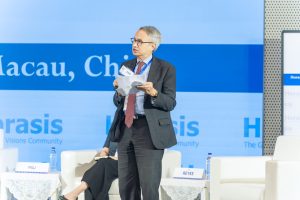
Alejandro Reyes, Senior Fellow, University of Hong Kong, Hong Kong
Hengqin was chosen deliberately. Barely a decade ago an expanse of aquaculture ponds and sugarcane fields facing Macau across the Lianhuajing Waterway, the island has been transformed into the Guangdong-Macao In-Depth Cooperation Zone, a jointly administered special economic area in which Macau residents enjoy near-native treatment and Mainland policy experimentation is given free rein. It is, in miniature, a working model of the cross-border integration that the wider region is groping toward: one system, two markets, a single ambition. Marking its tenth anniversary, Horasis brought its pan-Asian community to witness that experiment first-hand, and to ask what lessons Hengqin and Macau might offer for the rest of Asia’s cross-border cooperation.
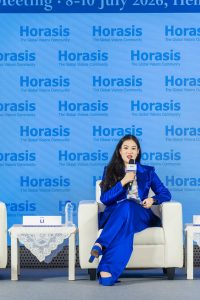
Angela Li, News Editor and Contributing Host, Phoenix TV, Hong Kong SAR, chairing the Opening Plenary
Welcoming delegates in the Tianmu Qintai foyer, Frank-Jürgen Richter, Chairman, Horasis, Switzerland, reflected that Horasis was marking a decade of sustained pan-Asian dialogue and cooperation with this, its tenth Asia Meeting. ‘Hengqin’s unique position, closely linked to Macau and located just minutes away, reflects a new model of regional integration that combines innovation, openness, and cross-border connectivity,’ he said, framing the meeting’s central question: how such hybrid regions might shape Asia’s next phase of growth, and what lessons Hengqin and Macau could offer to broader models of cross-border integration across Asia. Alongside him, welcoming delegates on behalf of Hengqin Talent Group, the zone’s own talent and enterprise-development agency, was Enoch Huang, Director, Hengqin Talent Group, China, who described the zone’s ambition to become the preferred base in the Greater Bay Area for entrepreneurs and international talent alike, citing the preferential tax regime, streamlined company registration, and the deliberate blending of Macau’s business culture with Mainland scale and manufacturing depth. His remarks set the tone for a meeting that would return, again and again, to the theme of hybrid geographies: places built neither wholly of the Mainland nor wholly apart from it, but as connective tissue between China and the world.
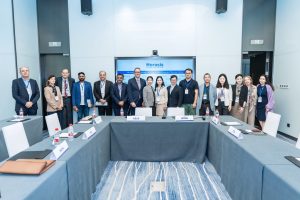
Asia’s diversity, in one dialogue
That tone carried directly into the afternoon’s Opening Plenary on Asia and World Economic Outlook, chaired by Angela Li, News Editor and Contributing Host, Phoenix TV, Hong Kong SAR. Opening the discussion, Li observed that the region’s economic outlook had grown harder to read from the outside in recent years, precisely because so much of Asia’s growth is now generated within the region itself rather than through exports to the West — a shift she felt Western commentary had been slow to register. Despite persistent global headwinds and structural realignments, panelists agreed, Asia continues to demonstrate remarkable economic resilience and adaptability, with its sustained commitment to advanced manufacturing, supply-chain modernisation and real-economy resilience positioning the region as the world’s anchor of stable, high-quality growth. Carlos Cid Alvares, Chief Executive Officer, Banco Nacional Ultramarino, Macau SAR, opened by noting that Macau’s own diversification away from a single-pillar gaming economy mirrors the wider Asian story: economies that once depended on a narrow base of exports or a single industry are now building deeper, more resilient foundations.
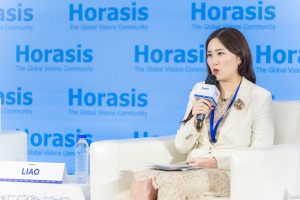
Bonnie Liao, Executive Director, Social Enterprise Research Academy, Hong Kong SAR
Viveka Kalidasan, Founder and Chief Executive Officer, River Ventures, Singapore, argued that Asian capital markets are increasingly self-sufficient, with regional venture and private capital now able to fund entire company life-cycles without recourse to Western exchanges. Venkata Ramana, Founder and Chief Executive Officer, AVERA, India, drew the audience’s attention to India’s continuing double role as both a manufacturing alternative and a consumption engine, while Xiang Bing, Founding Dean, Cheung Kong Graduate School of Business (CKGSB), China, closed the session by cautioning that China’s next phase of growth will be defined less by scale than by quality – by innovation, services and the green transition rather than by raw industrial output. Asia’s growing economic gravity, the panel concluded, is now a stabilising force for the world economy rather than merely a beneficiary of it.
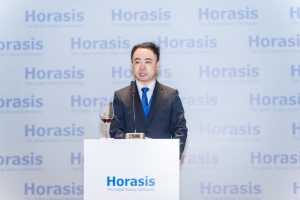
Chen Chao, Managing Director, Hengqin Talent Group, China welcoming participants during the Opening Dinner
After a short break, the conversation turned from growth to its quality. Chaired by Suneet Puri, Regional Head China and Hong Kong, Tata Consultancy Services (TCS), Hong Kong SAR, the plenary on SDGs as Catalyst for High-Quality Development examined how Asian economies are embracing the UN Sustainable Development Goals not as a compliance exercise but as the architecture of a new, higher-quality model of growth – one that places environmental stewardship, social progress and transparent governance at the heart of long-term value creation. Lisa Botos, Founding Partner, Private Partners & Co, Singapore, argued that family offices across Asia are increasingly treating SDG alignment as a fiduciary duty rather than a marketing exercise, reflecting a generational shift among the region’s wealth holders. Bill Kung, Founder and Chief Executive Officer, Ecovane Environmental, China, described how China’s environmental technology sector has matured from subsidised pilot projects into globally competitive exporters of wind and waste-management solutions. Bonnie Liao, Executive Director, Social Enterprise Research Academy, Hong Kong SAR, urged that social enterprise be treated as core economic infrastructure rather than a philanthropic afterthought, while Nguyen Quang Huan, Chairman, Halcom, Vietnam, reflected on Vietnam’s own experience of channelling infrastructure investment toward measurable development outcomes. The consensus among panelists: capital markets that reward transparency and long-termism will, over time, out-compete those that do not.
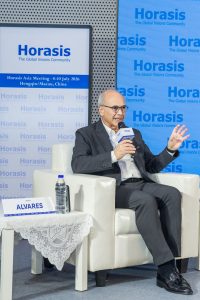
Carlos Cid Alvares, Chief Executive Officer, Banco Nacional Ultramarino, Macau SAR
From high-quality development the discussion widened, in the day’s third plenary, to the shape of globalization itself. Chaired by Jake Yu, Global Managing Partner, Peregrine Ventures, USA, the session on Reimagining Globalization: Asia’s Vision for an Open World confronted the retreat toward protectionism and fragmentation visible in parts of the world, and asked how Asia might instead champion an open, inclusive model of global exchange. Roger King, Founder and Chairman, ODS Holdings Inc., Hong Kong, argued that Asia’s deepening economic integration and expanding trade architecture are already generating new models of cooperation capable of reinvigorating globalization for a new era. Vinod Sekhar, Chairman, Petra Group, Malaysia, spoke of the need for ‘social capitalism’ – enterprise that is unapologetically profitable while doing right by employees, customers and the environment – as the operating principle for a more resilient globalization. Michael Yeoh, President, KSI Strategic Institute for Asia Pacific, Malaysia, noted that ASEAN’s expanding web of trade agreements gives the region unusual flexibility to remain open even as larger powers turn inward. Wang Huiyao, Founder, Center for China and Globalization, China, closed by observing that China’s growing economic gravity gives it both the opportunity and the responsibility to help sustain a rules-based global trading order, one reshaped for a more multipolar world rather than one built around a single centre.
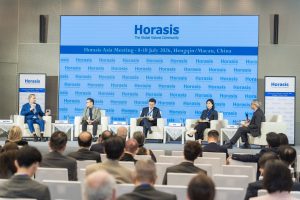
Closing Plenary – Charting Asia’s Path Forward
Speaking on behalf of the Chinese partner organization, Chen Chao, Managing Director, Hengqin Talent Group, China, remarked that Hengqin’s task was to make cross-border living as unremarkable as possible – shared healthcare, shared customs clearance, shared professional qualifications – so that talent could move as freely as capital already does. Amid the toasts and cross-table introductions that followed, delegates from more than thirty countries began the conversations that would carry through the following two days – a fitting opening to a meeting built, quite literally, around the idea of connection.
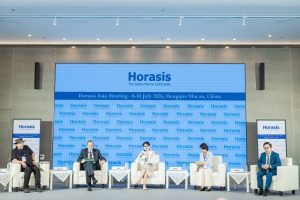
Plenary – Asian Horizons in the Age of the 5th Industrial Revolution
The program then shifted its focus to technology, opening with the plenary on Technology as Asia’s Catalyst for Global Leadership. Session chair Rajive Kaul, Chairman, Nicco Group, India, argued that Asia’s technological ascendance is redefining global innovation paradigms and competitive dynamics. From quantum computing to artificial intelligence, panelists agreed, Asian institutions and enterprises are pushing the boundaries of technological possibility, creating new vectors for economic growth and social development. Michael Gale, Group Chief Executive Officer, Al Liwan Group, UAE, spoke of the deepening ties between Gulf capital and Asian technological execution, a partnership he expects to intensify. Matilda Ho, Founder and Managing Director, Bits x Bites, China, brought the conversation down to earth, arguing that Asia’s food-technology sector is quietly becoming one of the world’s most important laboratories for feeding a growing population sustainably. Srikar Reddy, Executive Vice Chairman, Sonata Software, India, argued that Asian technology firms are shifting from being cost-competitive service providers to genuine intellectual-property owners in their own right. Akira Tsuchiya, President, The Global Institute (TGI), Japan, closed the panel with a reminder that none of this technological leadership matters unless the workforce is retrained alongside it – a theme that would recur throughout the day’s dialogue sessions.
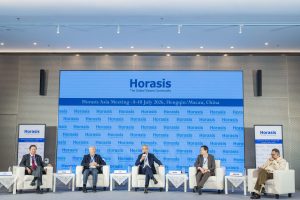
Plenary – Reimagining Globalization – Asia’s Vision for an Open World
Following the plenary, participants joined twenty parallel dialogue sessions, intersected by a plenary on Asian Horizons in the Age of the 5th Industrial Revolution, chaired by Christina Lim, Founder and Chief Strategist, ChrisSpeak, Singapore, considered how Asia’s blend of technological dynamism and deep human tradition positions the region as a natural laboratory for exploring where machine intelligence and human capacity best complement one another. Claude Béglé, Chairman, SymbioSwiss, Switzerland, argued that the 5th Industrial Revolution, unlike its predecessor, must be judged not by efficiency alone but by whether it deepens rather than displaces human meaning – a philosophy he would return to two evenings later in Macau. De Kai observed that Asia’s manufacturing depth gives it an unusual advantage in industrial AI – the ability to deploy machine intelligence not in the abstract but directly on the factory floor. Wilfred Wong Ying-wai, Executive Vice Chairman & Executive Director, Sands China, Macau SAR, drew a direct line between Macau’s own hospitality-technology integration and the wider regional trend of humanising automation rather than merely applying it. Zhang Yuxia, Chair, Zhongcai Financial New Media Fund, China, closed by suggesting that the convergence of ancient collective wisdom with cutting-edge innovation offers the world new models for economies that are both highly advanced and deeply humane.
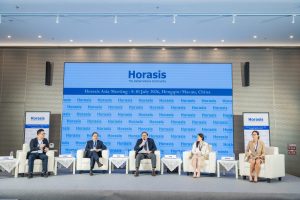
Plenary – SDGs as Catalyst for High-Quality Development
The Closing Plenary, Charting Asia’s Path Forward, chaired by Alejandro Reyes, Senior Fellow, University of Hong Kong, Hong Kong, gave participants the chance to reflect on the convergence of innovation, sustainability and economic transformation that had run through the two days of dialogue. Anson Chan, Chairman and Managing Director, Bonds Group of Companies, Hong Kong, urged the community to translate insight into action, warning against summits that generate enthusiasm but not follow-through. Skeikh Abdulla Zayed bin Saqr Al Nayhan, Chairman, Abdulla Bin Zayed Investment Group, UAE, spoke of the deepening Gulf-Asia investment corridor as a durable structural shift rather than a passing cycle. Janet Pau reminded delegates that Asia’s diversity is itself a competitive advantage, so long as regional institutions are built to reflect it rather than flatten it. Wang Dong, Executive Director, Institute for Global Cooperation and Understanding, China, closed the session – and the day – with a call for regional cooperation frameworks that are additive rather than exclusive, capable of strengthening Asia’s collective voice in global governance without closing doors to partners beyond the region.
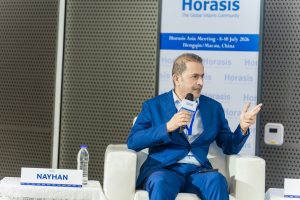
Skeikh Abdulla Zayed bin Saqr Al Nayhan, Chairman, Abdulla Bin Zayed Investment Group, UAE
For the first time in its history, Horasis carried a single summit across two geographies. On 10 July, participants transferred across the border to Macau. The day opened with a dedicated seminar at The Londoner Macau curated by the Macau Chamber of Commerce and chaired by Linda Hu, President China, AIESEC Alumni Association. Macau’s strategic position within the Guangdong-Macao In-Depth Cooperation Zone, the session argued, makes it a compelling destination for international investment, offering unique access to both Mainland China and global markets across finance, tourism and technology.
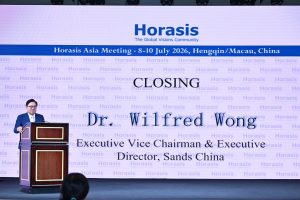
Wilfred Wong, the host of the Macau-focused seminar on the last summit day
Kevin Ho, Vice President, Macau Chamber of Commerce, Macau SAR, opened proceedings by setting out how Macau’s business community sees its role evolving within the Greater Bay Area – not as a satellite of the Mainland economy but as a specialised gateway combining Portuguese-language ties to Lusophone markets, a common-law-adjacent legal tradition, and deep familiarity with international finance. Elaine Wong, of the Commerce and Investment Promotion Institute of the Macao SAR, Macau SAR, outlined the concrete mechanisms through which international investors can access the Hengqin-Macau cooperation zone, from streamlined licensing to preferential tax arrangements for qualifying enterprises.

Viveka Kalidasan, Founder and Chief Executive Officer, River Ventures, Singapore, making a point during the Opening Plenary
Chan Chou Weng, Deputy Director, Macau Economic & Technological Development Bureau detailed the government’s own diversification strategy, emphasising technology, traditional Chinese medicine, modern finance and the ‘big health’ sector as the four pillars of Macau’s post-gaming economy. Jun Liu, Rector, City University of Macau closed the keynote segment by describing the university’s role in supplying the bilingual, cross-culturally fluent talent that this diversification will require, positioning Macau’s higher-education sector as an underappreciated asset in the wider Greater Bay Area story.
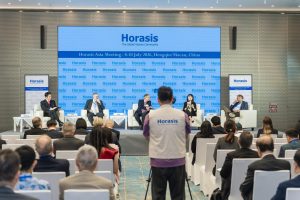
Plenary – Technology as Asia’s Catalyst for Global Leadership
The keynotes gave way directly to a panel discussion chaired by José Carlos Matias, Chief Executive Officer, Macau Business bringing together Echo Chan, Chair, Macau European Chamber of Commerce, Constantino Mousinho, General Manager, Banco Comercial Português, John Teng, Chief Representative, PBEC, Hong Kong SAR, and Jeffrey Wong, Founder and Chief Executive Officer, Spring Gate Capital, Singapore. The panel dwelt on the practicalities of doing business in Macau – regulatory clarity, banking relationships, and the softer question of how European and Asian business cultures continue to blend in a city shaped by five centuries of exactly that encounter. Closing remarks were delivered by Wilfred Wong Ying-wai, Executive Vice Chairman & Executive Director, Sands China, Macau SAR, and Frank-Jürgen Richter, Chairman, Horasis, Switzerland, who thanked the Macau Chamber of Commerce for curating a morning that had given delegates a concrete sense of the city’s opportunities.
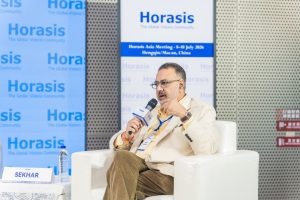
Summit co-chair Vinod Sekhar, Chairman, Petra Group, Malaysia
The tenth Horasis Asia Meeting leaves us with a simple but important conclusion: cooperation across borders is no longer merely an aspiration in Asia – in Hengqin and Macau, it is a working model, one that other parts of the region, and indeed the world, would do well to study. Over three days we heard how Asian technology, trade, culture and capital are converging into something more coherent than the sum of their national parts.
Asia’s story over the coming decade will be written as much in places like Hengqin and Macau – new, hybrid, deliberately experimental – as in its established capitals.
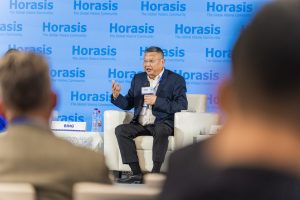
Xiang Bing, Founding Dean, Cheung Kong Graduate School of Business (CKGSB), China
Horasis looks forward to continuing to chronicle that story, and to welcoming its global community once again at the next edition of the Horasis Asia Meeting, to deepen the dialogue, renew the commitment, and carry the spirit of Hengqin and Macau’s connection forward into Asia’s next decade of cooperation.
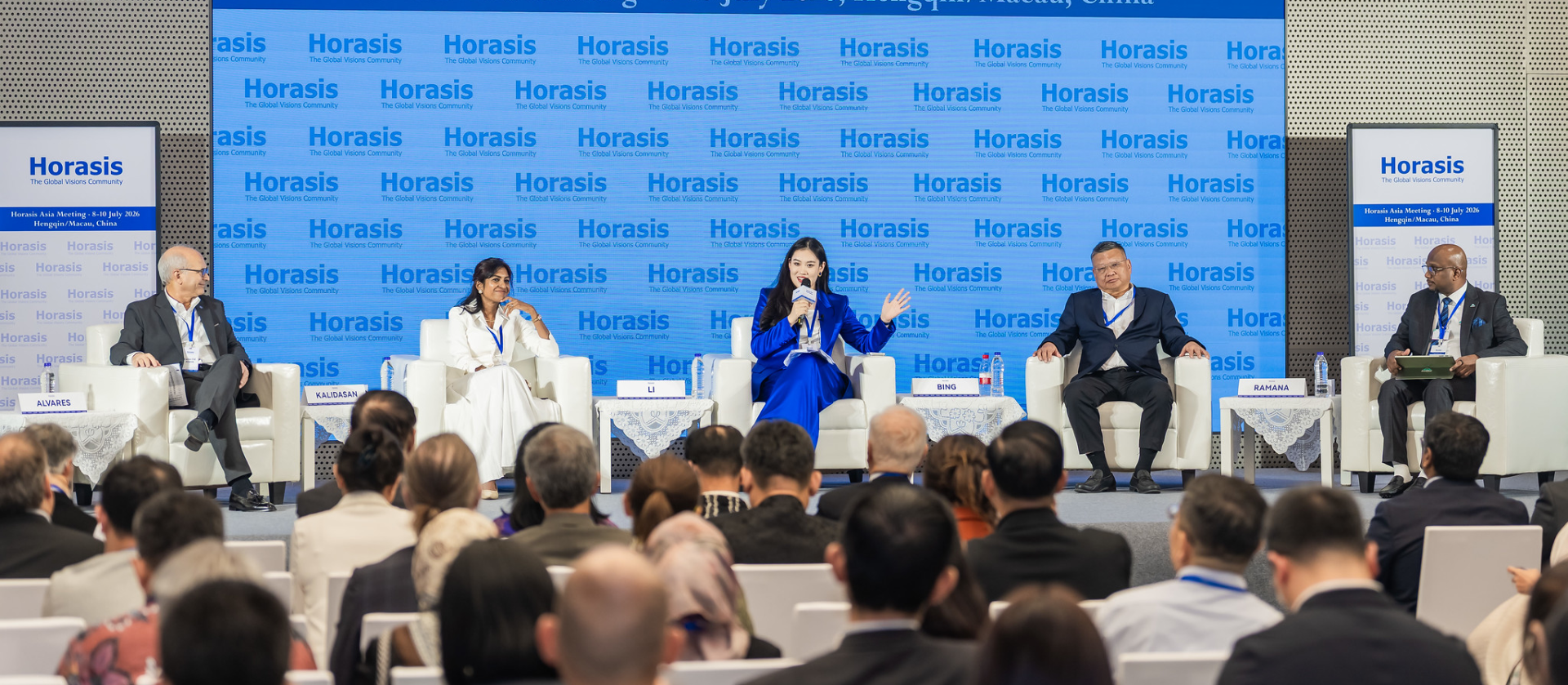
Featured photo of Horasis Asia Meeting 2026 Opening Plenary – Asia and World Economic Outlook